A saving you can report
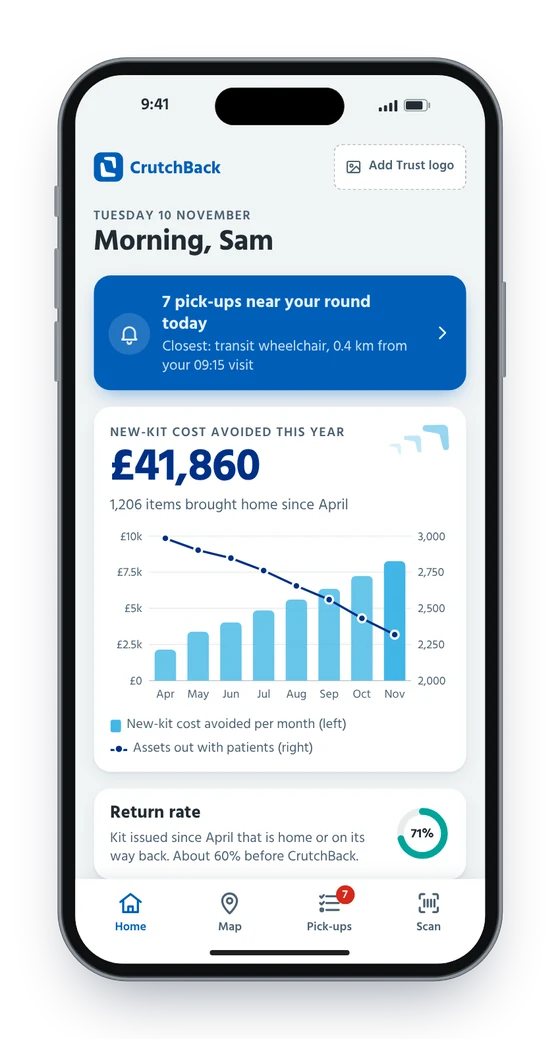
- Avoided new-kit spend, counted item by item
- Monthly report ready for the board pack
- Live count of assets out and their value
Walking-aid recovery for hospital Trusts
CrutchBack finds loaned crutches, frames and wheelchairs out in the community, asks patients to get them ready, and puts each pick-up on a visit your community teams are already making.
Every crutch, frame and wheelchair leaves the ward with an asset number on it. Most patients have no idea they're meant to return it, and nobody knows where it ended up. So your Trust buys it again.
How it works
Like a boomerang, every walking aid leaves with a way home built in. CrutchBack sends each one a "get me home" message, and makes the return easy for the patient and cheap for the Trust.
Scan the sticker that's already on the kit when it's issued, or import your loan records. Nothing new to label.
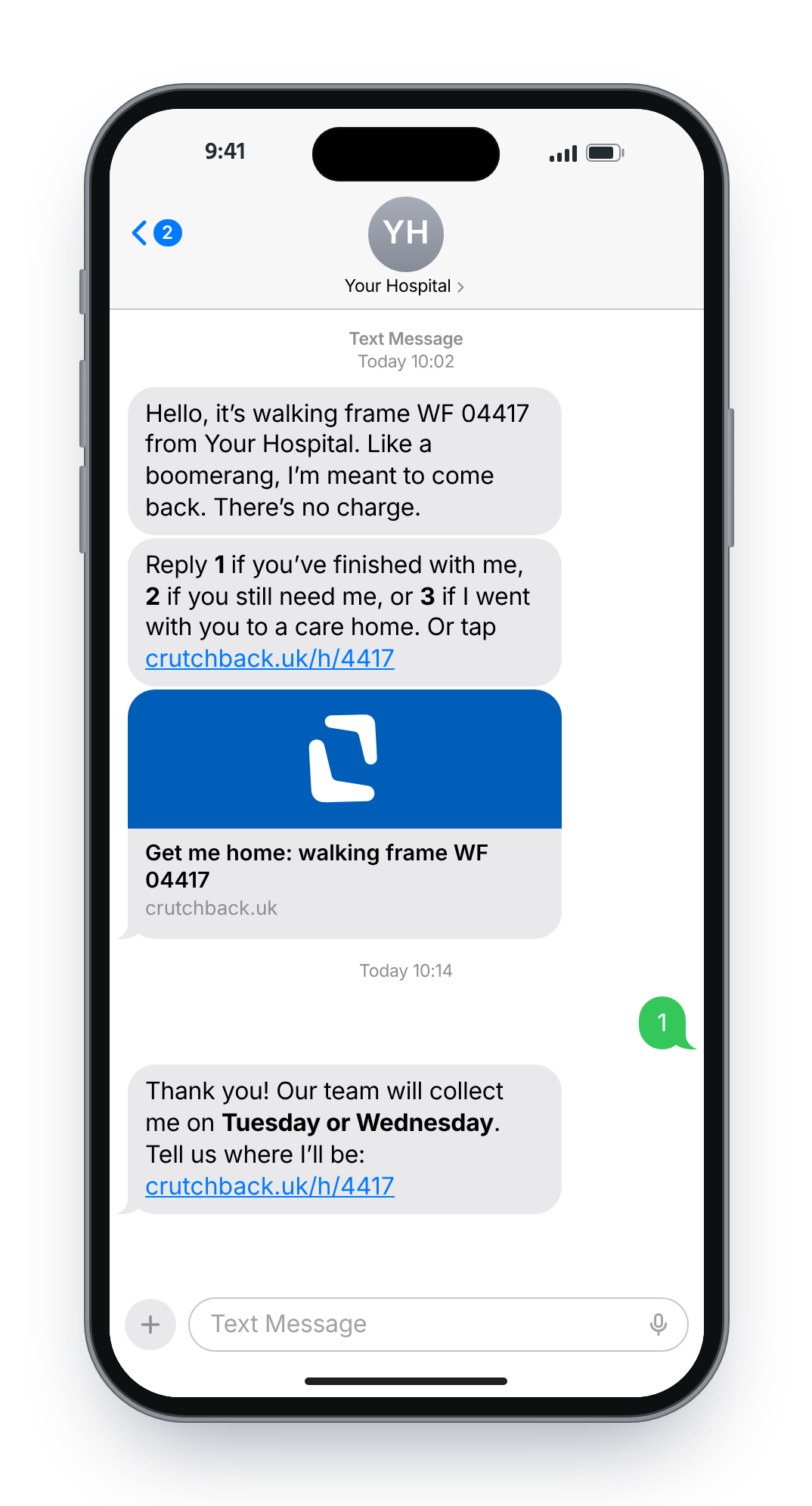
At the right time, the patient gets a text from your hospital. One tap tells you they've finished with it, still need it, or it's at a care home.
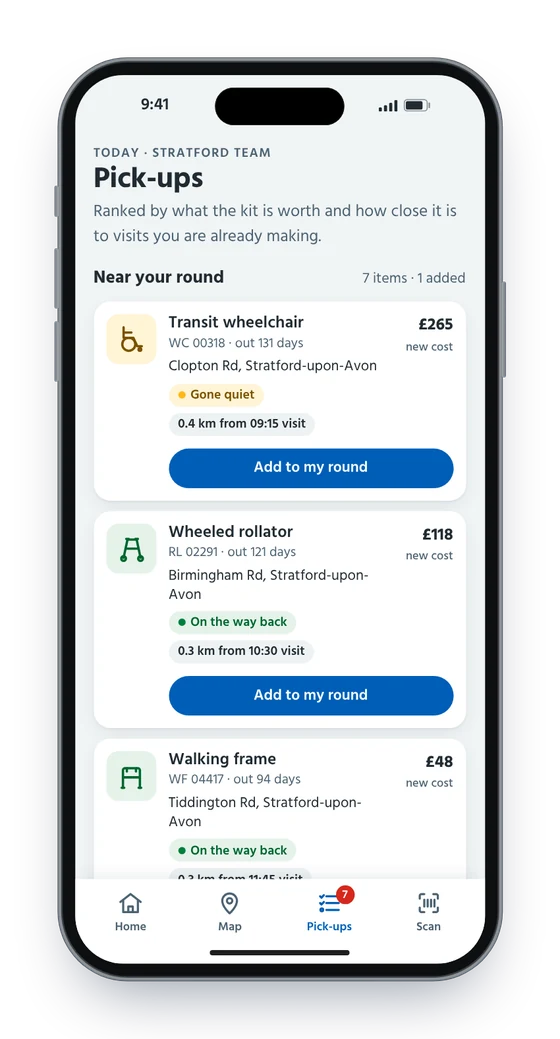
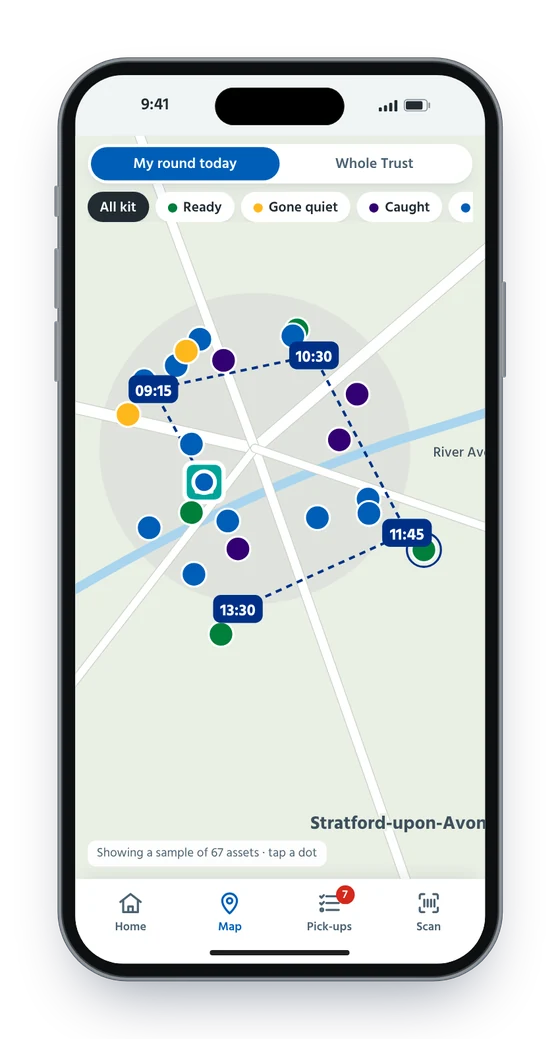
Ready kit appears on a map for community nurses and therapists, ranked by value and how close it is to visits they've already planned.
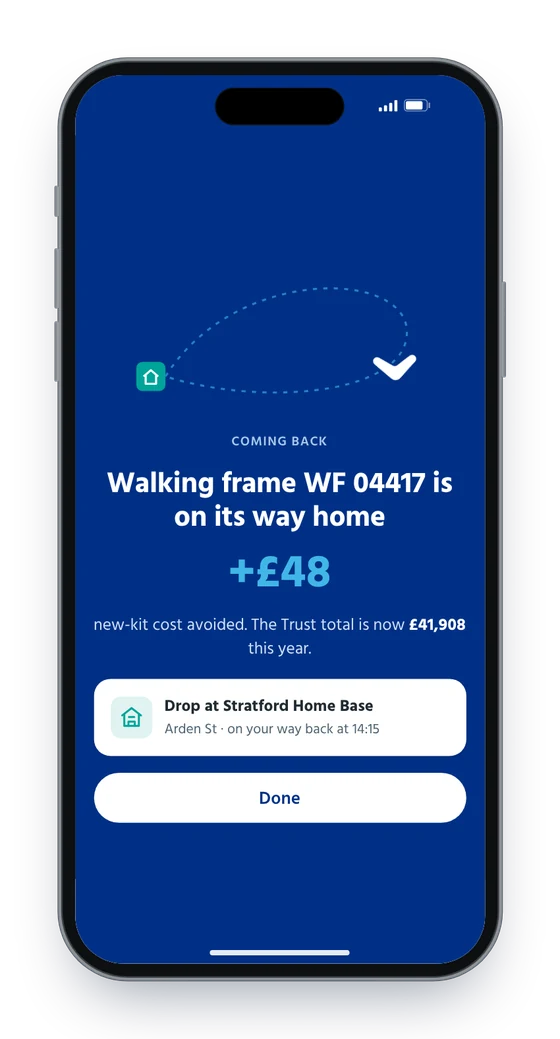
Kit is scanned in at a drop-off zone on site, cleaned and reissued. The saving is counted the moment it lands.
For patients
Texts and pages carry your Trust's name and logo. The tone is friendly and clear: no charge, nobody's in trouble, and help to get the kit ready so they don't need to be in when it's collected.
For NHS staff
Community nurses and therapists see only the kit that's ready and near a visit already in their diary. Collecting it takes under a minute. They can actively plan a collection if visiting or passing, or respond to a ‘nearby’ notification alert.
Benefits
Savings calculator
Move the sliders to match your Trust. Starting values are illustrative.
Estimate only. Excludes staff time, cleaning and the cost of waits for kit.
The evidence
Hospitals across the country already know how much walking-aid kit goes missing, and what getting it back is worth.
Royal Berkshire got back only 38% of crutches and 15% of frames last year, and puts the saving from returns at about £70,000 a year.
Source: Royal BerkshireNHS England says an average hospital could save up to £46,000 a year at a 40% return rate.
Source: walking aid reuse guidanceIn 2019, 66 Trusts spent over £14m on 560,000 walking aids.
Source: Stockport case studyPricing
Per Trust, excluding VAT. Rolling monthly, no setup fee during the pilot.
Pays for itself when two wheelchairs, or eight walking frames, come home each month.
Start a pilotBeyond walking aids
Tag it at issue, nudge the patient, collect it on a visit you are already making. The more an item costs, the faster it pays back.
Tablets, pulse oximeters and blood pressure cuffs sent home with patients. Easy to return by prepaid post.
Often left in the home after a death. Families get a gentle, unhurried message, never a chase.
24-hour and 7-day recorders that patients forget to bring back to clinic.
Machines no longer used after treatment ends or a patient moves away.
Often rented, so every day one sits unused in a home is a day you pay for.
Larger kit, often run by your local equipment service. We can work with them too.
Illustrative examples for a mid-size Trust. Item values are round estimates of replacement or rental cost.
Data and safety
CrutchBack tracks the kit, not the patient. Clinical records stay in your own systems.
Asset number, rough location, contact number for the text, and the patient's replies. Nothing clinical.
Data stored and processed in the UK, deleted when the item comes home.
DTAC evidence, a DPIA template and a data security toolkit submission, ready before go-live.
Patient pages built to WCAG 2.2 AA, with large text and plain English.
Questions
No. Patients get a text with a link to a simple web page. Community staff use the CrutchBack app.
They tap "I still need it" and we check again in four weeks. Nobody is chased while they're still using it.
Mostly community nurses and therapists, and only when the kit is close to a visit they've already planned. Patients can also drop it at Home Base. Some Trusts may add a dedicated driver for the rest.
Care-home kit is marked as Caught. The home gets its own list of Trust items to return in bulk, or to keep under a recorded loan.
CrutchBack reads the asset numbers you already use. Loan records can be imported from a spreadsheet to start, with system links added later.
The dashboard shows the return rate against your baseline, items out, and the new-kit cost avoided. The 90-day pilot ends with a short report you can take to the board.
Start small